DE
DE  EN
EN  PT
PT  FR
FR  ES
ES  RU
RU  AR
AR  ZH
ZH 
How to Choose the Right Industrial Endoscope for Your Application
Choosing the right industrial endoscope is essential for achieving accurate inspections, efficient maintenance, and reliable diagnostics across industries such as aerospace, automotive, energy, and precision manufacturing. With today’s advanced imaging technologies and specialized designs, endoscopes come in a wide range of sizes and functions. Understanding your specific application needs ensures you select a tool that enhances productivity and prevents costly downtime. The first step is to clearly define your inspection requirements. Different tasks demand different capabilities. Some industries require tools that can withstand high temperatures, while others need extremely small diameters to access micro-channels. Knowing whether you are inspecting turbine blades, automotive engines, or welded pipes will guide you toward the correct type of endoscope.
Probe diameter is one of the most important considerations. Smaller diameters are ideal for tight and delicate environments such as aerospace components or medical device channels. Mid-sized diameters between 3.9 mm and 6 mm suit most automotive and mechanical inspections. Larger probes are chosen for heavy-duty applications like pipelines. Selecting the correct diameter ensures smooth accessibility without compromising image clarity. Insertion length should also match your inspection depth. Long pipes, boilers, and turbine systems require extended probe lengths to reach internal surfaces, while shorter lengths are sufficient for compact parts. Choosing the right length improves maneuverability and ensures full surface coverage.
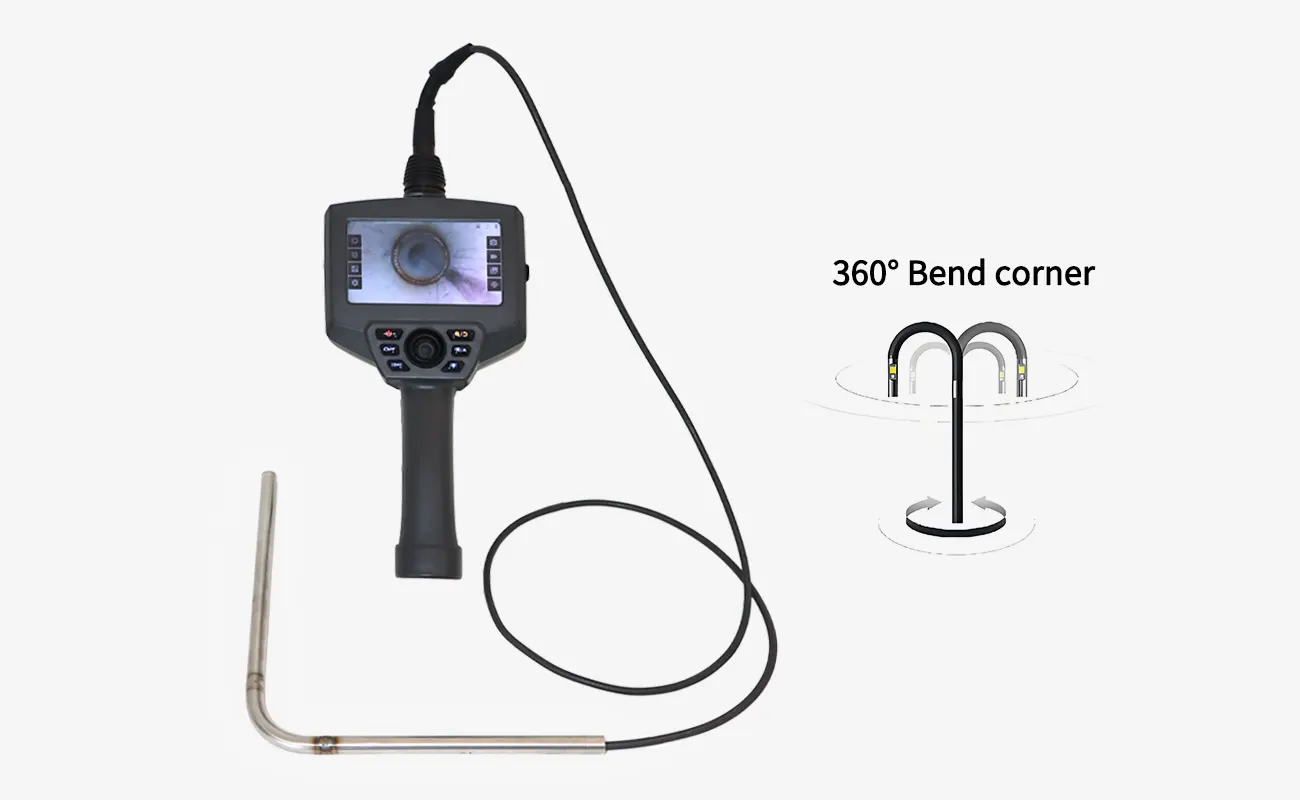
Viewing direction significantly affects inspection outcomes. A direct front view works well for forward-facing imaging, while side view optics are better for inspecting chamber walls or angled surfaces. Dual-camera and interchangeable head designs offer both perspectives, allowing operators to switch viewing modes instantly. This flexibility is especially valuable for complex structures where multiple angles are required. Bending capability determines how effectively the endoscope navigates through corners or curved paths. Basic two-way bending may be sufficient for simple inspections, but demanding applications often require four-way or full 360° articulation. Endoscopes with ultra-small bending sections provide excellent control in narrow spaces, allowing technicians to reach areas that were previously inaccessible.
Image quality is another decisive factor. High-definition sensors, optimized optical systems, and powerful illumination improve clarity and help identify hairline cracks, corrosion, or surface defects. Modern endoscopes integrate intelligent algorithms that enhance contrast, reduce noise, and deliver accurate visuals even in challenging conditions. Clear imaging directly influences the reliability of inspection results. Many applications require special functional features. These may include measurement tools for sizing defects, interchangeable probe tips for different view angles, high-temperature resistance for furnace or engine inspections, or wireless connectivity for real-time collaboration. Matching these capabilities to your workflow ensures you get maximum value from the equipment.
Durability is equally important because industrial environments can be harsh. Oil, dust, vibration, and chemicals can damage low-quality instruments. Choosing an endoscope with reinforced sheathing, waterproof design, and robust mechanical components ensures long service life and stable performance, even under demanding conditions. Reliable after-sales support is a major advantage when selecting a supplier. Training, spare parts availability, fast technical service, and the ability to customize probes all contribute to smooth operation. Manufacturers with strong R&D capabilities—such as those producing ultra-thin, ultra-long, or multi-functional designs—provide greater long-term flexibility for specialized industries.
While budget matters, it should be balanced against long-term performance and downtime savings. A high-quality industrial endoscope may cost more initially but often provides far greater value through improved inspection efficiency, fewer equipment failures, and longer usable life. In conclusion, choosing the right industrial endoscope requires careful consideration of your inspection environment, technical needs, and long-term goals. By paying attention to key factors such as diameter, bending ability, viewing direction, sensor quality, durability, and support, you can select a tool that ensures safer operations, more accurate inspections, and higher productivity.