ES
ES  EN
EN  PT
PT  FR
FR  RU
RU  DE
DE  AR
AR  ZH
ZH 
Industrial Endoscopes in Shipbuilding: Precision at Every Weld
Shipbuilding is one of the most complex and demanding manufacturing industries, where structural integrity, safety, and durability are non-negotiable. Modern vessels rely on thousands of welded joints across hulls, pipelines, engines, and internal structures. Many of these welds are hidden within enclosed or hard-to-reach spaces, making inspection a critical challenge. Industrial endoscopes have become an indispensable tool in shipbuilding, delivering precision inspection at every weld without the need for disassembly or destructive testing. Weld quality directly affects a ship’s strength and long-term reliability. Defects such as cracks, lack of fusion, porosity, and corrosion can compromise structural performance and lead to costly repairs or safety risks at sea. Traditional inspection methods often struggle to access internal welds in narrow compartments, double-hull structures, and complex piping systems. Industrial endoscopes solve this problem by providing clear visual access to internal weld areas through small openings, enabling thorough inspection even in confined spaces.
High-definition endoscopic imaging allows inspectors to detect minute weld imperfections with exceptional clarity. Advanced optical systems and powerful illumination ensure consistent image quality even in low-light environments deep within ship structures. Forward-view and side-view probes enable inspectors to examine weld beads, root passes, and heat-affected zones from multiple angles, ensuring no critical detail is overlooked. Flexibility is another key advantage of industrial endoscopes in shipbuilding. Articulating probes can navigate complex geometries, bends, and intersections within piping and structural frameworks. Ultra-thin probe designs allow access to tight gaps without altering the ship’s structure. This adaptability significantly reduces inspection time while improving coverage and accuracy across different ship components.
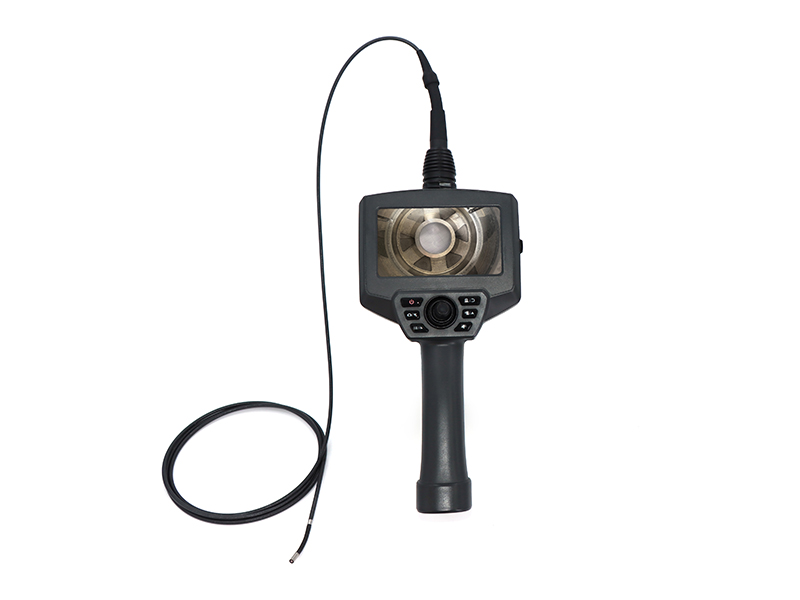
Endoscopic inspection also supports nondestructive testing (NDT) standards commonly applied in shipyards. By documenting internal weld conditions with high-resolution images and videos, inspectors can create traceable inspection records that support quality audits, classification society requirements, and long-term maintenance planning. Visual data can be archived and compared over time to monitor corrosion progression or structural fatigue in critical weld areas. In addition to new ship construction, industrial endoscopes play a vital role in maintenance and repair operations. During dry dock inspections, endoscopes allow engineers to assess internal welds and structures without extensive dismantling. Early detection of weld degradation enables targeted repairs, minimizing downtime and reducing maintenance costs. This proactive approach enhances vessel safety and operational efficiency throughout its service life.
Digital integration further enhances the value of endoscopic inspection in shipbuilding. Modern systems support image storage, measurement functions, and compatibility with digital inspection platforms. When combined with advanced analysis tools, endoscopic data can help shipbuilders and operators make informed decisions about repair priorities and lifecycle management. As ship designs become more advanced and regulatory standards continue to rise, precision inspection tools are more important than ever. Industrial endoscopes meet this demand by delivering accurate, reliable, and efficient weld inspection solutions. From hull structures to complex piping systems, they ensure precision at every weld, supporting the construction of safer, more durable, and higher-quality vessels in today’s global shipbuilding industry.