ZH
ZH  EN
EN  PT
PT  FR
FR  ES
ES  RU
RU  DE
DE  AR
AR 
Signal Stability in Long-Distance Endoscopic Inspections
In industrial inspection, the ability to reach deep, confined, and complex structures is essential. Applications such as pipeline inspection, turbine evaluation, boiler systems, and large casting analysis often require endoscopes with extended insertion lengths. However, as the probe length increases, maintaining signal stability becomes a critical technical challenge. Ensuring consistent image quality, real-time responsiveness, and accurate data transmission over long distances is key to achieving reliable inspection results. Signal stability in long-distance endoscopic inspections refers to the ability to transmit high-quality visual data from the probe tip to the display system without degradation. As the insertion tube extends, the signal must travel through longer transmission paths, which increases the risk of attenuation, interference, latency, and noise. Without proper design and engineering, these factors can result in blurred images, delayed response, or even signal loss—compromising inspection accuracy and efficiency.
One of the primary challenges is signal attenuation. As electrical or digital signals travel over extended distances, their strength naturally decreases. In long endoscope probes, especially those used in pipelines or large industrial systems, this attenuation can reduce image clarity and resolution. To address this, advanced endoscopic systems incorporate high-quality transmission cables with optimized shielding and conductivity. These materials are carefully selected to minimize signal loss and maintain consistent performance even over several meters of insertion length. Electromagnetic interference (EMI) is another factor that affects signal stability. Industrial environments are often filled with electrical equipment, motors, and high-frequency systems that can disrupt signal transmission. To counter this, modern endoscopes use multi-layer shielding technologies that protect internal signal pathways from external interference. This ensures that the captured image remains stable and free from distortion, even in electrically noisy environments such as power plants or manufacturing facilities.
Digital signal processing also plays a crucial role in maintaining stability. Advanced endoscopic systems convert analog signals into digital data at the earliest stage possible—often directly at the probe tip. By transmitting digital signals instead of analog ones, the system reduces susceptibility to noise and maintains higher image fidelity over long distances. Built-in processors further enhance signal quality by applying real-time correction, noise reduction, and image stabilization algorithms. Another important aspect is bandwidth management. High-definition imaging requires large amounts of data to be transmitted quickly and accurately. In long-distance inspections, insufficient bandwidth can lead to lag, reduced frame rates, or compression artifacts. High-performance endoscopes are designed with optimized data transmission protocols that ensure smooth, real-time video streaming without compromising image detail. This is particularly important in dynamic inspections where immediate visual feedback is necessary.
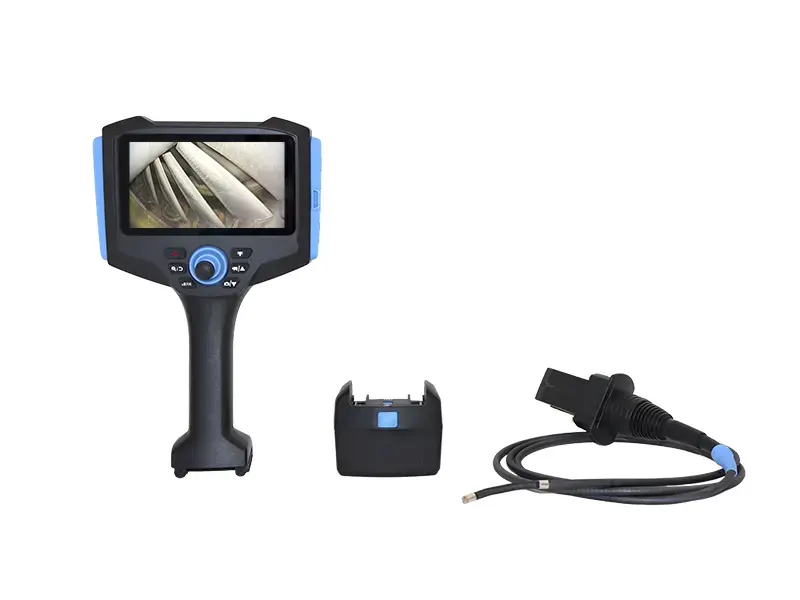
Mechanical design also contributes to signal stability. The insertion tube must not only be flexible and durable but also protect internal wiring and optical fibers from damage. Repeated bending, twisting, and movement during inspections can stress internal components, potentially affecting signal transmission. High-quality endoscopes use reinforced internal structures and flexible yet robust materials to maintain consistent signal pathways even under demanding conditions. In addition, connector integrity is critical in modular or long-reach systems. Poor connections between components can introduce signal loss or instability. Precision-engineered connectors with secure locking mechanisms ensure stable electrical contact and prevent signal interruptions during operation. This is especially important in systems with interchangeable probes or extended cable configurations.
The importance of signal stability becomes evident in real-world applications. In pipeline inspections, for example, engineers rely on clear, uninterrupted imaging to detect corrosion, blockages, or structural defects over long distances. In aerospace and power generation, long-reach endoscopes are used to inspect internal components without disassembly, where any signal distortion could lead to missed defects. Stable signal transmission ensures that inspectors can trust what they see and make accurate decisions. As industrial inspection continues to evolve, the demand for longer reach and higher precision will only increase. Future developments in signal transmission may include fiber-optic communication, advanced wireless technologies, and AI-assisted signal enhancement. These innovations will further improve reliability, enabling even deeper and more complex inspections with uncompromised image quality.
In conclusion, signal stability is a fundamental requirement in long-distance endoscopic inspections. Through advanced materials, shielding technologies, digital signal processing, and robust mechanical design, modern industrial endoscopes overcome the challenges of extended transmission distances. By ensuring clear, stable, and real-time imaging, these systems empower industries to perform accurate inspections in even the most difficult-to-reach environments, supporting safer operations and more efficient maintenance practices.